

I ended 2025 experiencing my very first Australian Christmas — and to my surprise, the entire spread was cold. Cold meats, cold salads, cold desserts. A perfectly normal tradition here, but a complete shock to my system. Across three continents and countless family gatherings, Christmas has always meant hot food.
In many Oriental cultures, hot food is considered essential for preventing illness, restoring balance, and supporting recovery. If you have a persistent cough, all the more reason to avoid cold foods and drinks and instead nourish yourself with warmth (Kim et al., 2024).
It reminded me how deeply culture shapes our understanding of health, comfort, and celebration. Filipino traditions, in particular, are a fascinating blend of Chinese–Japanese influences and Spanish heritage — a tapestry of rituals that carry meaning far beyond the dinner table.
This year, my sibling and I kept our maternal traditions alive with intention and pride. We prepared:
- 12 fruit varieties for abundance
- Noodles for long life
- Fish for prosperity
- Dumplings for gold ingots
- Hot steamed rice (non‑negotiable)
- 12 grapes eaten from the last minute of the year into the first minute of the next
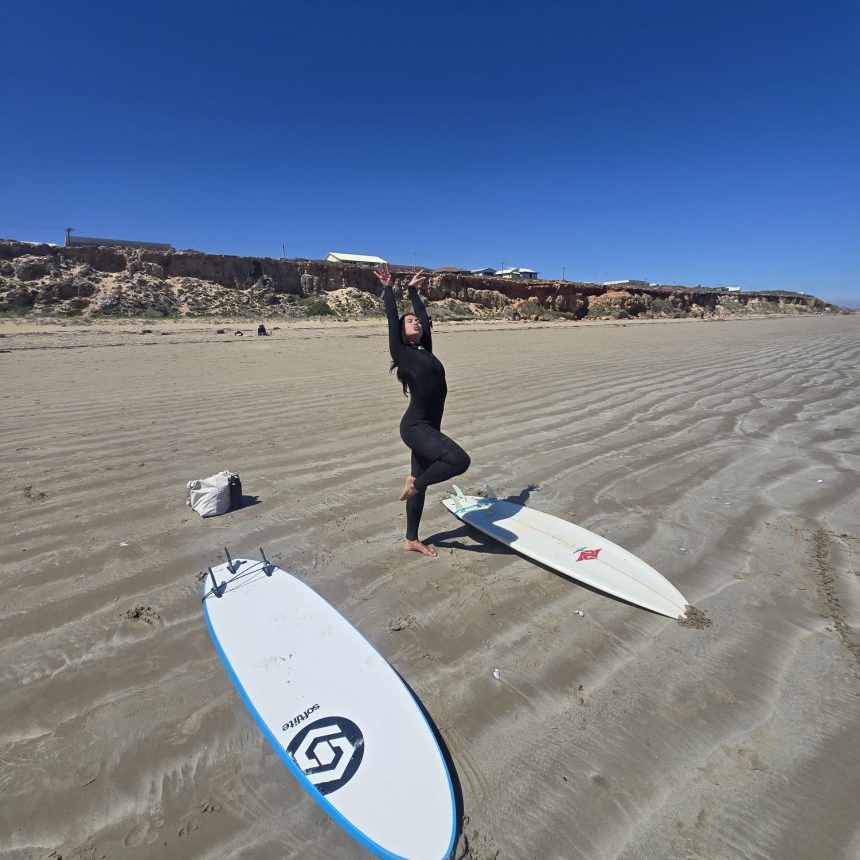
We celebrated New Year’s Eve together, called family across the world, and then took our first road trip to Middleton and Goolwa in South Australia — a retreat into the calm solace of isolation across the ocean away from society.
I spent the first morning of the year surfing, awakened by a 5:30am sunrise glowing over the horizon, the riptides shimmering like molten glass. It was breathtaking. It felt like a reset.
But this article isn’t about cultural comparisons or my dream come true with learning how to surf in 2025. What I really want to explore are three things:
- Goal setting for 2026
- Cultivating self‑awareness for the awareness of others and our environment
- Self‑reflection as a daily practice
1. Goal Setting for 2026: Making This Our Best Year Yet
There’s one thing you can do if you don’t want 2026 to look like 2025 — and that is to change the way you plan and execute your goals. Before the year ended, I listened to Codie Sanchez on The Big Deal, and her breakdown of goal‑setting hit me with the force of truth. It wasn’t just motivational; it was structural. It was a blueprint.
A few ideas stood out to me immediately:
Irreversible direction goals
Soul screams if you have not tried
These aren’t small, incremental goals. These are the kind of goals that, if you don’t attempt them, your 80‑year‑old self will feel the sting of regret. Codie calls this the regret minimization framework, borrowed from Jeff Bezos — the idea that you should choose goals based on what your future self would be devastated not to have attempted.
This is where she introduces the concept of goal gravity — the force that pulls your habits, decisions, and daily actions toward a single, meaningful direction. Small goals don’t create gravity. They don’t change your behaviour. They don’t demand anything new from you.
Big goals do.
As T.S. Eliot said,
Only those who will risk going too far can possibly find out how far they can go.
And Dave Chappelle’s reminder echoes the same truth:
At any given moment, the one with the bigger dream wins.
But you can only win if you know what you want — otherwise, you end up living inside someone else’s dream.
Exploration vs. Exploitation
Codie talks about a fork in the road:
- Exploitation is repeating what already works.
- Exploration is obsessing over what might work — the things you’ve never tried.
Most people stay in exploitation mode. They refine, optimise, and polish the familiar. But breakthroughs — the kind that change your life — come from exploration. From doing the thing you’ve never done. From risking looking foolish. From questioning the habits you stopped questioning years ago.
2026 is the year to explore.
Name the Year. Frame It. Achieve It.
One of my favourite takeaways was this:
Name the year
Frame it
Achieve it
Codie names every year before she sets any goals. Naming creates identity. Identity shapes behaviour. Behaviour shapes outcomes.
So I’ve named my 2026 — and I encourage you to do the same. Give your year a title that feels like a contract with your future self. A declaration. A direction.
First Principles and Backwards Timelines
Another powerful idea came from Elon Musk’s approach to goal‑setting:
Start with first principles, not assumptions.
Codie reframed it like this:
Never say “Can’t”, unless it is illegal, contractual, or limited by the laws of physics.
Everything else is a preference, a resource issue, or a choice.
Once you know what is actually impossible, you work backwards from the outcome you want. If your goal is big — truly big — you reverse‑engineer every dependency until you arrive at the present moment. This turns dreams into architecture.
So for 2026, I’m asking myself:
- What is the path to build it?
- What sacrifices am I willing to make?
- What skills do I need to acquire?
These questions are uncomfortable — but they’re clarifying.
The Four Goal Categories
Codie breaks her goals into four categories:
Relationships, Work, Travel, and Fun.
I love this structure because it acknowledges that a meaningful life is multidimensional. It’s not just about achievement — it’s about connection, exploration, and joy.
For 2026, I’m using a similar framework, ensuring that my goals reflect not just ambition, but alignment.
More Of, Less Of: The Anti‑Goal Method
Warren Buffett’s 5/25 rule is brutal but brilliant:
Write 25 long‑term goals.
Circle the top five.
Avoid the other 20 at all costs.
More goals = more failure.
More focus = more progress.
So I’m writing my own More Of / Less Of list for 2026 — not just what I want to add, but what I’m willing to subtract.
Because subtraction is often the real catalyst for transformation.
Daily Scoreboards and Measurable Habits
Sam Walton believed that
everything improves when everyone knows the score.
Codie applies this to personal goals through daily measurable habits — the small, consistent actions that compound into a different life.
It takes 21 days to build a habit.
It takes 90 days to build a lifestyle.
2026 is Day One.
2. Cultivating Self‑Awareness (for Ourselves, Others, and the Environment)
Self‑awareness isn’t just about introspection — it’s about orientation. It’s about understanding how we move through the world, how our choices affect others, and how our presence interacts with our environment. Living in Australia, with its vast coastlines, fragile ecosystems, and deep Indigenous respect for land, has made me more conscious of the spaces I occupy and the footprints I leave behind.
But cultivating awareness begins with a simple, personal question:
What do I want this year to feel like?
Not what I want to achieve. Not what I want to produce. But what I want to feel.
This question forces us to step out of autopilot and into intention. It invites us to design a year based on alignment rather than obligation.
Then comes the next layer:
What am I tired of dealing with? What would make this a good year for me?
These questions are clarifying. They help us identify the emotional clutter we’ve been carrying — the patterns, relationships, habits, or expectations that drain us. They also help us define the conditions that support our wellbeing, creativity, and sense of purpose.
Self‑awareness is not self‑obsession. It is self‑responsibility.
When we understand our internal landscape, we become more attuned to others. We communicate with more compassion. We notice the environment with more reverence. We move through the world with more care.
Awareness is a practice — a muscle — and it begins with asking better questions.
3. Self‑Reflection: A Daily Ritual
One of the simplest and most powerful ways to cultivate awareness is through a daily check‑in. Not a long journal entry. Not a deep emotional excavation. Just a three‑sentence ritual at the end of each day:
One thing that drained you. One thing that helped you. One thing you are proud of.
That’s it.
It doesn’t have to be profound. It doesn’t have to be poetic. It just has to be honest.
This practice helps you track your emotional patterns without judgment. Over time, you begin to see what consistently depletes you, what reliably supports you, and what strengths you’re building quietly, day by day.
Then, close your entry with one final line — a single sentence that answers:
What stayed with me today? What shifted? What mattered?
Imagine 365 of these sentences. A quiet record of your year. A soft archive of who you were becoming.
If you want to take it one step further, end each week by choosing one good moment — something small, something warm, something worth remembering — and place it into a “joy jar.”
Then, when you hit a hard moment later in the year, you’ll have a collection of beautiful things to look back on. Proof that even in difficult seasons, there were sparks of light.
Self‑reflection doesn’t change your life overnight. But it changes the way you live your life — and that changes everything.
Closing Thoughts
This season — my first Australian Christmas, my first New Year’s sunrise on the surf, which is a dream come true for me. This quiet retreat into the coastline has reminded me that life is always inviting us to evolve. To honour where we come from while embracing where we are. To build a year that feels aligned, intentional, and alive.
2026 is a blank canvas. Name it. Frame it. Achieve it.
Reference List
Kim, J., Lee, J., Lee, E., & Park, J. (2024). Research status of East Asian traditional medicine treatment for chronic cough: A scoping review. PLOS ONE, 19(1), e0296898. https://doi.org/10.1371/journal.pone.0296898
Sanchez, C. (2024). How to make 2025 your best year yet [Audio podcast episode]. In The Big Deal. Spotify. https://open.spotify.com/episode/4HxLgaS94Braa5s4x6WqyG?si=jR1pLH3uRe23TpryGINPBg
 Artist & Academic